

Xsens: Dual Antenna RTK GNSS/INS for Rugged and OEM Applications
Xsens has expanded its navigation portfolio with two new Dual Antenna RTK GNSS/INS products: Xsens Sirius Dual Antenna and Xsens Avior Dual Antenna. Both combine a dual-antenna u-blox ZED-X20D GNSS receiver with Xsens sensor fusion to deliver true heading, centimeter-level RTK positioning, and integrated heave, without depending on magnetic measurements or platform motion. The two products share the same core navigation performance but target different integration models: Sirius as a rugged, enclosed, ready-to-install unit, and Avior as a compact OEM module for deep embedded integration.
The key benefit of a dual-antenna GNSS/INS over a single-antenna system is the ability to derive true heading directly from the GNSS antenna baseline, rather than from magnetometers or vehicle motion. This matters most for platforms that:
Heading accuracy scales with antenna baseline length, and both products publish the same figures:
Both units also provide integrated heave output, specified at better than 5 cm for heave periods up to 29 s, and better than 6 cm for periods up to 40 s.
The key benefit of a dual-antenna GNSS/INS over a single-antenna system is the ability to derive true heading directly from the GNSS antenna baseline, rather than from magnetometers or vehicle motion. This matters most for platforms that:
- Need accurate heading before they start moving
- Operate at low speed or remain stationary for extended periods
- Work near steel structures, motors, or other sources of magnetic disturbance
- Require both precise position and heading from a single navigation solution
Heading accuracy scales with antenna baseline length, and both products publish the same figures:
| Antenna Baseline | Heading Accuracy |
| 0.5 m | 0.2° RMS |
| 1 m | 0.1° RMS |
| 2 m | 0.05° RMS |
Both units also provide integrated heave output, specified at better than 5 cm for heave periods up to 29 s, and better than 6 cm for periods up to 40 s.
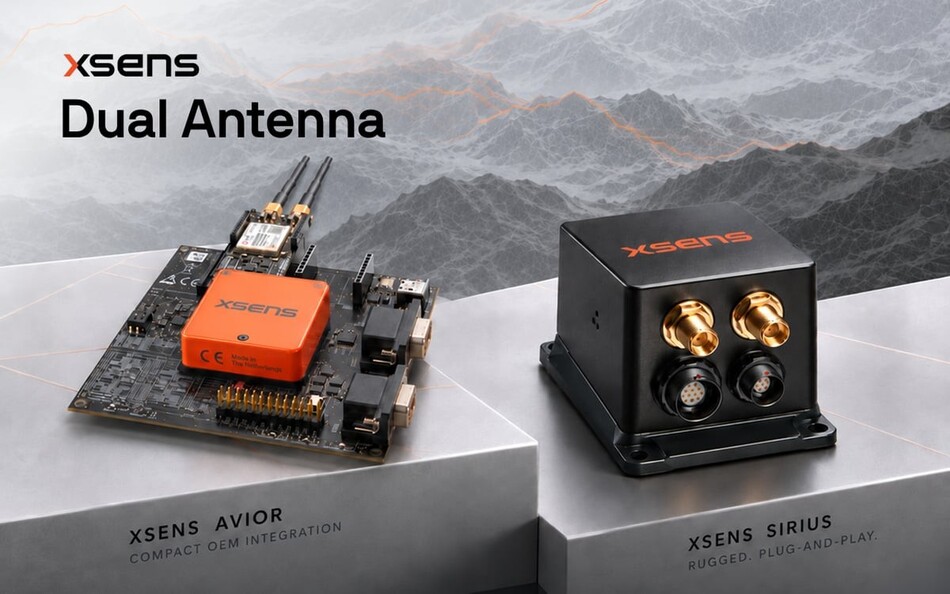
Xsens Sirius Dual Antenna - Rugged, Ready-to-Install
Sirius is built for exposed and demanding environments where a self-contained, enclosed unit is preferred over a bare module.
Key specifications:
Typical applications: marine and offshore systems, surveying and mapping platforms, autonomous ground vehicles, UAVs, and defense/SATCOM systems.
Xsens Avior Dual Antenna - Compact OEM Integration
Avior delivers the same core navigation capability in a low-SWaP form factor designed for deep integration into customer electronics and mechanical designs.
Key specifications:
Sirius or Avior? Choosing the Right Fit
The decision largely comes down to integration approach rather than navigation performance, since both products share the same heading, positioning, and heave capabilities.
Either way, customers get the same Dual Antenna advantages: true heading at standstill, centimeter-level RTK positioning, and integrated heave, from a single navigation solution.
Further data on the specs can be found in the data sheet. If you are interested in the module, we can provide you with the Eval-Kit free of charge on loan. Please contact your SE Account Manager or send us an e-mail to vertrieb@spezial.com.
Sirius is built for exposed and demanding environments where a self-contained, enclosed unit is preferred over a bare module.
Key specifications:
- IP68-rated aluminum housing, MIL-STD-202 tested
- Dimensions: 56.5 × 40.9 × 36.75 mm, weight: 103 g
- Position accuracy: 0.6 cm + 1 ppm CEP; velocity: 0.03 m/s RMS
- Input voltage 4.5–24 V; typical power consumption <1 W
- Interfaces: RS232, RS422, CAN, CAN-FD
- Support for RTK, PPP-RTK, Galileo HAS, and PointPerfect correction services
- ITAR-free
Typical applications: marine and offshore systems, surveying and mapping platforms, autonomous ground vehicles, UAVs, and defense/SATCOM systems.
Xsens Avior Dual Antenna - Compact OEM Integration
Avior delivers the same core navigation capability in a low-SWaP form factor designed for deep integration into customer electronics and mechanical designs.
Key specifications:
- Dimensions: 36.8 × 40 × 15.7 mm, weight: 35.2 g
- Typical power consumption <0.5 W; input voltage 3.2–5.1 V
- Position accuracy: 0.6 cm + 1 ppm CEP; velocity: 0.03 m/s RMS
- Interfaces: UART, SPI, I²C, CAN, CAN-FD (USB, RS232, RS422 available via development kit or external transceiver)
- Operating temperature: -40°C to 85°C
- ITAR-free
Sirius or Avior? Choosing the Right Fit
The decision largely comes down to integration approach rather than navigation performance, since both products share the same heading, positioning, and heave capabilities.
- Choose Sirius for a rugged, enclosed, ready-to-install system — particularly for marine, surveying, or outdoor autonomous applications operating in harsh conditions.
- Choose Avior for a compact, low-SWaP OEM module that integrates directly into your own electronics and mechanical design.
Either way, customers get the same Dual Antenna advantages: true heading at standstill, centimeter-level RTK positioning, and integrated heave, from a single navigation solution.
Further data on the specs can be found in the data sheet. If you are interested in the module, we can provide you with the Eval-Kit free of charge on loan. Please contact your SE Account Manager or send us an e-mail to vertrieb@spezial.com.